A methodology for creating new ideas

This is a post is intended to give people a methodology for creating new ideas.
I have won awards for illustrations using this method ie “How To Manage Brilliant People” -2009 National Azbee Awards Gold and Bronze

A lot of the time when I create an editorial illustration an idea just pops into my head … but sometimes this does not happen, so I have this little methodology for creating new ideas that has helped me time and time again.

The idea behind this methodology is similar to writing a song. There are only a few musical notes, but by rearranging their order, length and speed you can create an infinite amount of songs.

Step 1 – Important Words

Try and think of the most important words related to your project … usually 2 to 4 words.

So for this project the creative brief was rather easy because it basically spelled it out:

Empowering Teachers with Technology

… but from experience it’s usually not too hard to think of 2 or 3 words.

So we now have our words: Empower, Teacher, Technology

Step 2 – Word Association

Next, for each of these 3 words .. think of other things associated with them  … if you need help with this you can consult a  Thesaurus or see what images are associated by searching Google Images or Flickr. These are the “notes” you will rearrange into “songs” … or ideas.

Empower Teachers/Education Technology
  • Bridge
  • Helping Hand
  • Ladder
  • Crane
  • Super Hero/Cape
  • Power
  • Electricity
  • Motor
  • Spark
  • Ignite
  • Teacher
  • Desk
  • Books
  • Brain
  • Chalk Board
  • World Map
  • Apple
  • Class room
  • Graduation Cap
  • Diploma
  • Computer
  • Computer Chip
  • Satellite
  • Space Travel
  • Math Formulas
  • Schematics
  • Rockets
  • Molecules
  • DNA
  • Petri Dishes
  • Telescopes
  • Microscopes
  • Light Bulb

Step 3 – “make a song”

Now that you have your “notes” think of ways you can rearrange  them to convey  meaning. Pick a word from each column and see if you can create an interesting idea.  There are a number of ways to do this … change their size, their physical relationship to one another, their properties/material (metal=strong, ice=cold), etc.

Let’s see … what can we do? Maybe …

  • A crane driven by a teacher lowering a light-bulb into a student’s head.
  • A student climbing a DNA ladder to draw a light-bulb on a chalkboard
  • Students and a teacher crossing a bridge of computers to the moon
  • etc

r4

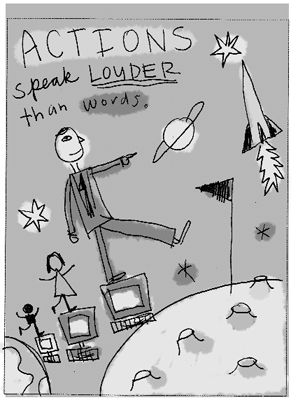
“A Bridge to places out of this world”
Students and a teacher crossing a bridge of computers to the moon

r4

“Ride The Brain Train”
The teacher’s brain is a vehicle that takes students to new places via technology/computer
r4

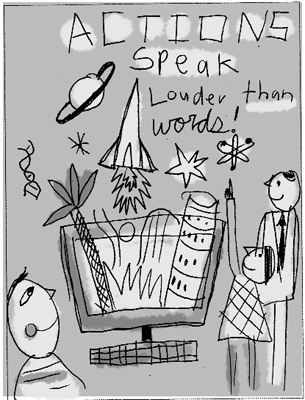
“Knowledge Explosion”
leveraging the window/portal metaphor

r4

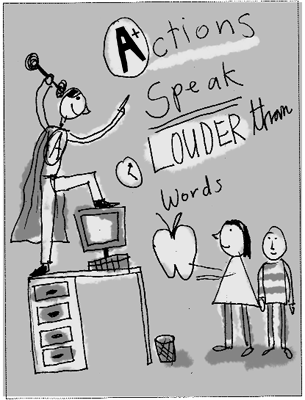
“Super Teacher”
Teacher in a heroric position (foot on computer) a cape inspiring students

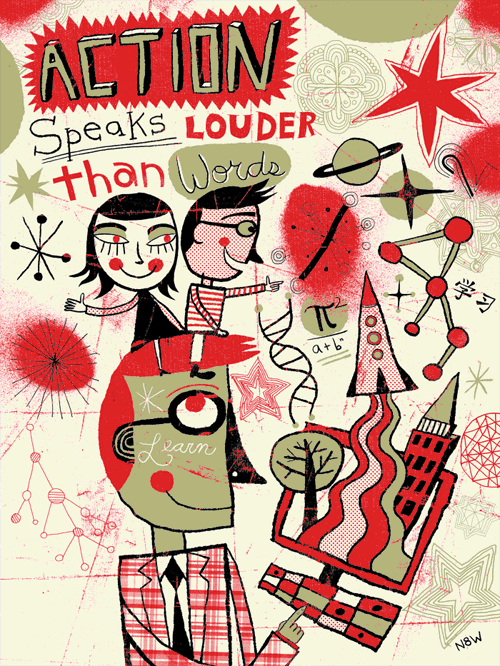
Here is the idea the client decided to go with …

final

I would love to hear if you have any methods for creating ideas???  Please post in comments below :)

Related Links:

This entry was posted in Editorial, Headlines, Illustrator Help. Bookmark the permalink. Post a comment or leave a trackback: Trackback URL.
  • LavenderField
    Thank you Nate, these are brilliant ideas, which I passed on to my daugher who's studying marketing and advertising. :)

    www.lavenderfield.etsy.com
  • andreaebert
    Nate,
    thank you very much!!!
    Andrea Ebert
  • I find that if I "think" about it, my ideas come out to complicated in the sense that most people just don't get the visual. So, I try and stop thinking words and try and do strictly visuals... get a little day dream/mental animation going. I try and keep words out of it. Once I get to seeing something good, as weird as it often is... its often a more understandable or at least more appealing result than I would have had with words.
    ...do like your method... will try it as I sometimes see the same daydream between projects.. and that's not too helpful! Thanks, great art, great site, excellent instruction
  • I think my work method is more simple. I just note in my sketchbook all the daily things which call my atteption. Sometimes they are stupid things, but, when you have to create an idea, these things can change and are the beginning of inspiration.
    However, you method is very interesting for me, and I think I will check it.
    Than you for sharing it with all us.
    Mar Ballesteros
    www.borumbara.blogspot.com
  • Thank you so much for sharing your method. Its always great to see how people deal with a project.
    The links you posted are also wonderful.
    Thanks again.
  • Hi Nate, been reading stuff on your site for the past 2 hours. I now have widescreen eyes! I still haven't finished!!
    I'm a graphic designer and thinking about going back to really what inspired me which was pencil & paper, so been trawling the net during breaks for material and info etc etc... and came across your Illustration Career page. You could charge people to read these pages 'seriously good stuff'!

    Thank you very, very, very much!

    Peteman
  • S.J. Hummer
    Nate,

    I never needed to create ideas I feel you just need to remember the ones you have already had sometimes and that reaction you felt when they sparked your noodle. In this remeberance I find myself (day or sleep) dreaming through these ideas making them visual for me.

    I also like to think of a time and place then look for relevant words in a dictionary. Time and place gives me a setting like writing a play. For example I began writing a miedieval play set in a valley for liesure and wrote on seperate pages words that I loved to visualize so that I could reference them later. You should be good at that since you toss words around on canvas. Creating the setting is a good starting point since it sets the mood & is a tool to change or manipulate the mood.

    I could go on and on in just ideas on how to have ideas. We should talk more. I love your art. Thanks for the emails.
  • dickie chikago
    nice one nate! Thanks.
  • Even without a block, this is a fun method. Great work!
  • Brilliant! love your method and it's inspirational to me! as well as your art.... keep it up..thanks for sharing.
  • I use a similar method but doodling mindlessly plays a big part. The mindless bit is very important. Getting your conscious mind out of the way to let ideas bubble up from that primeval all seeing super brain that exists in the subconscious. Its amazing what pops out and is related to the problem - sometimes admittedly in weird ways.

    I also collect strictly useful links on delicious to help my students. My collection of links to websites covering methods to be creative is here at http://delicious.com/rawstudio/creativity

    Cheers All
  • These are the same methods I have used for many years Nate. I read through and try to find most important words which sum up the article, look for any obviously descriptive words and make a list of all the graphic elements and objects that I can work with. Then I use my imagination to invent a scenario using a selection of these elements.

    Some academic articles with paragraphs of waffle can be challenging but generally there's usually at least one concrete element around which to develop an image.
  • wow fantastic, I had a project like this a while back, it's so cool to see how you solve the topic. Wish i had known about this then. :) I love the crane idea by the way. I think that many people working in the editorial field can benefit from this, not only illustrators.
  • thanx for share nate!
    you are genius!
    seeyou
  • Thank you: this is just what I need as I return to studying Design Fundamentals after the mid semester break. I'm terrified. You've helped. I'll be printing this out and adding it to my visual diary to refer back to :-)
  • i'm not an illustrator - or even a graphic designer - but i like to play make believe! i will definitely use this technique on my next project. thanks so much for this post!
  • Great advice and the end illustration is great. Thanks.
  • We used to call this "mind-mapping" when I learned it back in design college - I often forget to do it now that I'm in the *real world* but some of my best ideas have come from mind maps!

    I like your illustration style!
  • This is awesome thanks for posting!
  • eva
    Thank you very much ! Hope I can have more interesting ideas as well !
  • Great technique, thanks! I haven't used this process, and certainly will for my "Idea of the Day" post. It's really fun working some of my existing techniques out with kids and colleagues, to see what they come up with. If you are interested in other methods feel free to review my post "17 ways to stimulate new ideas" at http://www.kairostcheck.com/2009/06/19/idea-of-.... I'd love comments.
  • Richard
    It`s a very god idea. I think you are a very good internet teacher..jaja. I presented in the pincellation tour in Cordoba, when you explain this metod. i gave to me desire of take a photograf whit you, becauase i think you are a very factastic people. I don´t have a very good english if you don´t realize. Como vos no tenes un muy buen español,,jaja por algo necesitaste del traductor en la conferencia... y tampoco sabias que significaba un "destornillador" (que mierda es un destornillador no..jaja)

    Well Goodbye
    i wait for answers
  • I, too, often start with a combination of word associations and imagery when I am brainstorming. This method will really help me zero in on some fantastic visual ideas.Thanks for sharing this technique!
  • Thanks for that, Nate. I also like to follow Nancy Duarte's 5 rules for brainstorming.
    1. Postpone judgment of ideas
    2. Encourage wild, exaggerated ideas
    3. Quantity counts at this stage, not quality
    4. Build on ideas put forward by others
    5. Every person and every idea has equal worth.
  • Thanks Nate for fun word play!
    It's great to see how when you look in the columns at the individual words themselves, the look, well - pretty boring, but combining them into a "song" really helps to stimulate the mind visually.
  • Very nice. Thanks for sharing the process. This process is also used in the graphic design world as well. It's the best way to come up with some quality and conceptually strong logo design. You are educating and inspiring lots of people. Keep up the great work!
  • I would also recommend for people to try following this process without using words at all. The act of drawing out associations visually rather than listing them as words can be very useful. Images can suggest ideas and connections that words sometimes can't.
    Thanks for sharing your process Nate.
  • Muy buen método, gracias por compartirlo.
  • A Technique for Producing Ideas by James Young is a reccomended read for everybody in the creative industry as well. Thank you for a look in your creative method nate!

    best,

    PF
  • This is so great Nate! I think I already work with this process myself, but untill now it has been subconsciously. It's so nice to have it written!
  • very cool Melissa thanks .. I will be sure to check it out. I am sure this method or variations of it have been around for hundreds of years ... It's really just a variation of the alphabet ... making new words with letters .. sentences with words ... etc

    Be sure to check out http://creatingminds.org/tools/tools_ideation.htm ... there are tons more approaches there
  • Nate, the method you described sounds a lot like the method that Gabriele Rico, Ph.D. describes in her writing book, "Writing the Natural Way". Your way of generating ideas from the key words is what she would call, "clustering around a nucleus word". Instead of columns for the key words, she simply draws a circle around each one and banches off other words from it that are related to it.

    Although, she uses this method to come up with some writing ideas, the same can be used for illustration or art ideas. I actually read the book because it was recommended by my illustration teacher, Marshall Vandruff. He said it would help with composition. it's a good quick, read bursting with creative ideas.
  • Great variation of the "forced association" method! I will try it out with my writing students, it could be an interesting way of helping them to write a scene: start with three words that express what needs to happen in that scene, do the "song" and see whether that leads to a fresher version. Thanks!
  • claudia
    Great idea to use with teens! A format gets everyone going to places they didnt even know they could go. We use prompts sometimes, less formal but similar. Thank you. I refer friends and students to your website!
  • Ok I usually stay in the background but that information is
    "priceless." Now I am starting to understand why you are
    Nate Williams. Thank you,a lot!....
  • that's a clever idea, thanks for sharing. I like how rough your sketches are!
    C
    PS I don't have a method...maybe I should look for one...
  • What a great method!
    Thank you so much for sharing! This really helps!
  • Thanks for sharing this Nate, I am going to have some fun using your ideas busting machine with the kids I am working with.
    Good to share and great work
    I still haven't blogged about my poster win from you as it's being framed, as soon as I have it though, it will be done
    Lou
  • Farik Osman
    Having faced with occasional creative juice block ups can be pretty frustrating. If you don't sit down and run through these easy steps you can end up hurting yourself LOL. Great sharing :)
blog comments powered by Disqus